Seasonal timing from observations
A bloom and harvest calendar grounded in your plants.
Log when buds, flowers, ripening, and harvest actually happen. OrcharDex turns enough repeated bud, bloom, and harvest observations into plant-specific timing windows—and stays cautious when the history is sparse.
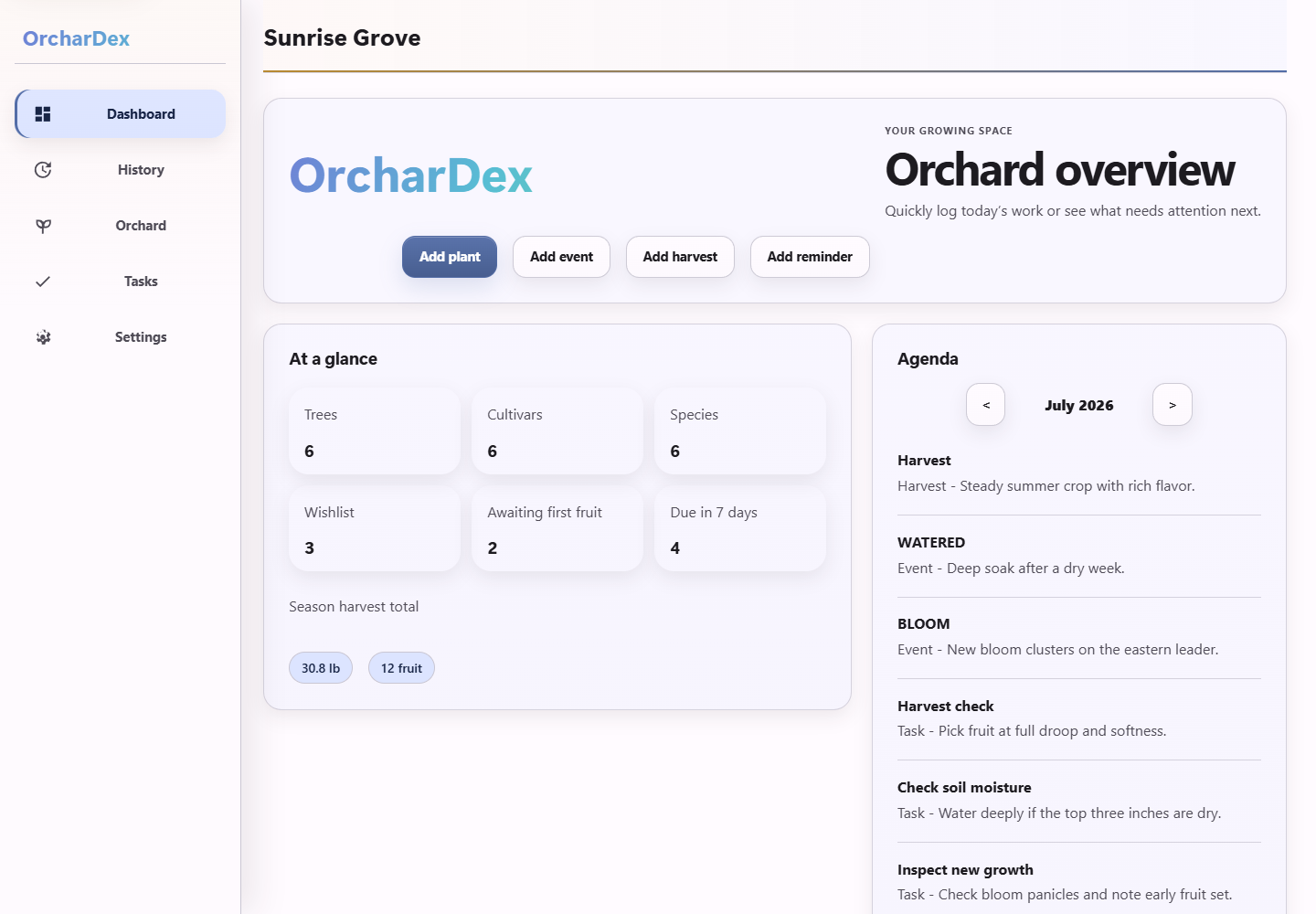
What is a bloom and harvest calendar?
It is a dated record of the stages you observe in edible plants across seasons. Instead of copying a single regional date onto every cultivar and garden, OrcharDex stores budding, flowering, ripe, and harvest events for the specific plant you logged. Those observations remain available even before there is enough evidence for a learned window.
Plant history comes first
When repeated seasons support a pattern, OrcharDex can summarize timing for that plant. It evaluates the available years and observations rather than assuming every crop follows one annual date. If the evidence is insufficient, stale, or inconsistent, the app lowers confidence or withholds a forecast window rather than presenting weak data as certainty.
Varied seasons are allowed
Some edible plants can have multiple or extended cycles. OrcharDex’s learning model can represent annual, multiple, extended, irregular, and insufficient regimes when the history supports them. That matters in subtropical and tropical gardens where a single spring-bloom template may not describe what a plant actually does.
Climate is context, not a substitute for observations
OrcharDex can retain climate and location context separately, but climate does not overwrite your plant’s phenology record. A generic climate band or weather signal cannot prove that a particular cultivar flowered or ripened. The app’s product principle is simple: observed plant timing and climate context should inform the gardener without being confused with each other.
What to log for better timing
Use dated present observations consistently. Record the plant, stage, date, and any useful intensity or notes. Mark absence or uncertainty when that is what you observed. Several seasons are more informative than one, and a dense cluster from one year should not automatically outweigh sparse evidence across years.
The short answer
Keep the record close to the plant.
OrcharDex is a free, installable web app for fruit trees, vegetables, herbs, and other edible plants. It connects plant identity, photos, reminders, observations, harvests, and history across phones, tablets, and computers.
Open OrcharDex